
Stem Activities for Kindergarten: A Comprehensive Guide (PDF Focus)
Kindergarten STEM, especially utilizing readily available PDF resources, fosters crucial early learning. These activities, like those run by Westfield High students, blend play and education seamlessly, offering hands-on exploration for young minds during breaks or structured learning times.
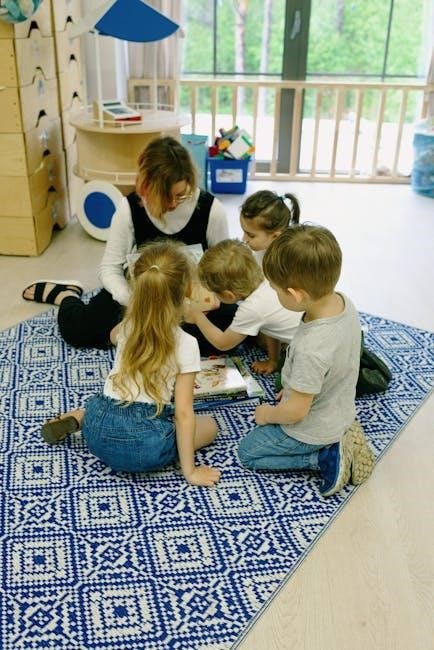
What is STEM Education in Kindergarten?
STEM education in kindergarten isn’t about creating future engineers overnight; it’s about cultivating a way of thinking. It stands for Science, Technology, Engineering, and Mathematics, but in early childhood, it’s experienced as integrated exploration rather than distinct subjects.
Think of it as encouraging children to ask questions, investigate their world, and solve problems. Activities, often found as convenient PDF downloads, focus on hands-on learning. For example, a simple building challenge – using blocks or recycled materials – incorporates engineering principles. Observing plant growth (a common PDF activity theme) introduces scientific observation.
Even using basic digital tools, like educational apps (technology), or counting and sorting objects (mathematics) contribute. The Westfield High School students’ preschool STEM stations exemplify this – they’re not teaching complex concepts, but fostering curiosity and a playful approach to learning. PDF resources make these accessible and easily implemented, providing structured yet flexible learning experiences.
Why STEM is Important for Young Learners
Introducing STEM concepts early, often through engaging PDF activities, lays a crucial foundation for future success. It’s not just about preparing children for STEM careers; it’s about developing essential life skills. STEM fosters critical thinking, problem-solving, creativity, and collaboration – abilities valuable in any field.
Kindergarten is a prime time to nurture these skills because young children are naturally curious and eager to explore. PDF-based STEM challenges provide structured opportunities for this exploration, allowing kids to experiment, make mistakes, and learn from them.
The Westfield example highlights this – students actively doing STEM, not just hearing about it. Utilizing readily available PDF resources empowers educators and parents to easily integrate these activities into daily routines. This early exposure builds confidence and a positive attitude towards learning, setting the stage for a lifelong love of discovery and innovation.
Benefits of Using PDF STEM Activity Resources
PDF STEM activity resources offer unparalleled convenience and accessibility for kindergarten educators and parents. They eliminate the need for extensive preparation time, often requiring only readily available household materials; This ease of use is particularly valuable for busy schedules, allowing for spontaneous learning opportunities.
Furthermore, PDFs are easily printable and shareable, making them cost-effective and adaptable to various learning environments – classrooms, homes, or even outdoor settings. The Westfield High School initiative demonstrates how structured activities, easily delivered via PDF format, can effectively engage young learners.
PDFs also allow for consistent implementation of activities, ensuring all children receive the same foundational experiences. They can be saved, organized, and revisited, fostering continuous learning and skill development. This format supports both independent exploration and guided instruction, maximizing the benefits of STEM education.
Core STEM Concepts for Kindergarten
Kindergarten STEM centers on foundational concepts: science exploration, basic technology, engineering design, and mathematical thinking, often delivered through engaging, printable PDF activities.
Science Exploration for 5-Year-Olds
Engaging five-year-olds in science through STEM activities, often found as downloadable PDFs, ignites their natural curiosity. These resources frequently focus on observation and simple experimentation. Think exploring the properties of everyday objects – sinking versus floating, or observing color changes with basic mixing.
PDF science activities can include printable observation sheets for nature walks, encouraging children to document plants and insects. Others might offer instructions for creating simple volcanoes using baking soda and vinegar, demonstrating chemical reactions in a safe and controlled environment.
Westfield High’s anatomy students utilized preschool STEM stations, showcasing how even complex scientific concepts can be broken down into age-appropriate explorations. PDFs provide a structured way to introduce these concepts, offering clear instructions and supporting materials for both educators and parents. The goal is to foster a love for scientific inquiry through hands-on learning.
Technology Integration (Simple Tools)
Integrating technology into kindergarten STEM doesn’t require expensive gadgets; many effective activities utilize simple tools and are readily available as PDF guides. These often center around introducing basic coding concepts through unplugged activities – using directional arrows on printed worksheets to guide a “robot” through a maze.
PDF resources can provide printable coding cards or sequencing activities, fostering computational thinking skills without a screen. Other options include using digital storybooks with interactive elements, prompting children to predict outcomes or solve simple problems.
While Westfield High students focused on hands-on stations, technology can supplement these experiences. PDFs can offer printable templates for designing simple machines, which children can then build physically. The key is to use technology as a tool to enhance learning, not replace it, keeping activities age-appropriate and focused on foundational skills.
Engineering Challenges (Building & Design)
Engineering challenges for kindergarteners, often found in accessible PDF formats, emphasize building, designing, and problem-solving through hands-on exploration. These activities encourage children to think creatively and develop spatial reasoning skills. Common challenges include building the tallest tower using limited materials like straws and tape, or designing a bridge that can support a small toy car.
PDF resources frequently provide step-by-step instructions, material lists, and even design prompts to guide young engineers. The Westfield High students’ preschool STEM stations likely incorporated similar building elements.
PDFs can also offer variations on challenges, allowing for differentiation based on skill level. The focus isn’t on perfect execution, but on the process of designing, testing, and iterating. These challenges foster resilience and a growth mindset, crucial for future STEM success.
Mathematical Thinking (Counting & Shapes)

Kindergarten STEM activities centered around mathematical thinking, conveniently packaged in PDF resources, seamlessly integrate counting, shape recognition, and early problem-solving skills. These activities move beyond rote memorization, encouraging children to apply mathematical concepts in practical, engaging ways. Examples include sorting objects by shape and color, counting the number of blocks used in a structure, or creating patterns with different materials.
PDFs often provide printable worksheets or game boards that reinforce these concepts. The STEM stations run by Westfield High students likely included elements of counting and shape identification within their activities.
PDF resources can also present challenges like estimating quantities or measuring lengths using non-standard units. This builds a foundational understanding of mathematical principles, preparing them for more complex concepts later on.

Popular STEM Activity Themes for Kindergarten (PDF Examples)
PDFs offer diverse themes – building, simple machines, plant life cycles, weather, and color mixing – providing engaging STEM experiences for kindergarteners, mirroring activities like those at Fort Meadow.
Building & Construction STEM Activities
Building and construction challenges are foundational STEM activities for kindergarteners, readily accessible through numerous PDF resources. These activities encourage spatial reasoning, problem-solving, and an understanding of structural integrity. PDF guides often present challenges like building the tallest tower using limited materials – blocks, straws, or even recycled items – prompting children to experiment with different designs and assess stability.
Another popular theme involves constructing bridges capable of supporting a specific weight, introducing basic engineering principles. Many PDFs include printable design templates or checklists to guide the building process. These activities aren’t just about the final product; they emphasize the iterative process of design, testing, and improvement.
Furthermore, construction-based STEM fosters collaboration and communication as children work together to achieve a common goal. The Westfield High School students’ preschool STEM stations likely incorporated similar building elements, demonstrating the power of hands-on learning. PDFs simplify implementation, offering clear instructions and material lists for educators and parents.
Simple Machines STEM Activities
Introducing simple machines to kindergarteners through STEM activities, often found in convenient PDF formats, lays the groundwork for understanding complex mechanics. These activities focus on levers, pulleys, wheels and axles, inclined planes, screws, and wedges, demonstrating how they make work easier. PDF resources frequently offer printable diagrams and instructions for building miniature versions of these machines.
For example, a lever activity might involve using a ruler and fulcrum to lift objects of varying weights, illustrating the concept of mechanical advantage. Pulleys can be explored using string and spools to lift small containers. Many PDFs include guided experiments with clear objectives and safety guidelines.
These hands-on explorations, similar to those potentially implemented by the Westfield High School students, encourage observation, prediction, and analysis. The focus isn’t on memorizing definitions, but on experiencing how these tools function. PDFs streamline preparation, providing all necessary materials lists and step-by-step instructions for engaging, age-appropriate learning.
Plant Life Cycle STEM Activities
Exploring the plant life cycle with kindergarteners through STEM activities, often conveniently packaged in PDF resources, is a fantastic way to introduce biological concepts. These activities move beyond simply labeling parts of a plant, encouraging observation and experimentation. PDFs frequently include printable sequencing cards illustrating the stages – seed, sprout, seedling, mature plant, flower, and fruit.
Activities might involve planting seeds in clear cups to observe root growth, or dissecting flowers to identify their components. Many PDFs offer guided observation journals for students to record their findings. These hands-on experiences, mirroring the engaging approach of educators like Karen Saunders, foster a deeper understanding of how plants grow and reproduce.
PDF resources simplify preparation, providing material lists and step-by-step instructions. The focus is on fostering curiosity and scientific thinking, not rote memorization. These activities connect classroom learning to the natural world, making science accessible and exciting for young learners.
Weather & Seasons STEM Activities
Kindergarten STEM activities centered around weather and seasons, often found in accessible PDF formats, provide a dynamic learning experience. These resources capitalize on children’s natural curiosity about the world around them, encouraging observation and data collection. PDFs frequently include printable weather charts for daily recording of temperature, precipitation, and cloud cover.
Engineering challenges might involve building structures to withstand simulated wind or rain, fostering problem-solving skills. Activities could also explore how animals adapt to different seasons, linking science to life science concepts. Like the engaging STEM stations run by Westfield High students, these activities prioritize hands-on exploration.
PDFs streamline preparation, offering pre-designed templates and instructions. These resources allow educators and parents to easily integrate STEM learning into discussions about seasonal changes and weather patterns, promoting scientific literacy in young children.
Color Mixing & Reactions STEM Activities
Color mixing and simple chemical reaction STEM activities, conveniently packaged in PDF resources, ignite kindergarteners’ curiosity and introduce foundational scientific concepts. These PDFs often feature guided experiments using safe, everyday materials like baking soda and vinegar, or food coloring and water.
Children can predict what will happen when colors are combined, fostering hypothesis formation and observation skills. Exploring reactions, like fizzing mixtures, introduces the idea of chemical changes in a visually engaging way. These activities echo the hands-on learning approach demonstrated by Westfield High students’ preschool STEM stations.
PDFs simplify setup, providing clear instructions and material lists. They encourage exploration of cause and effect, and allow for documentation of observations through drawings or simple written notes, building early scientific communication skills. These colorful explorations make learning fun and memorable.

Finding & Utilizing Kindergarten STEM PDFs
Numerous online platforms offer kindergarten STEM PDFs, providing accessible and structured activities. These resources, like those used in Westfield’s preschool stations, simplify lesson planning and implementation.
Free Printable STEM Activity PDFs
The internet is brimming with free, printable STEM activity PDFs perfectly suited for kindergarten learners. These resources are invaluable for teachers, homeschoolers, and parents seeking engaging, low-cost educational materials. Many websites dedicated to early childhood education offer a selection of downloadable STEM challenges, experiments, and worksheets.
These free PDFs often focus on foundational STEM concepts, such as building simple structures, exploring colors and mixing, or identifying shapes. They frequently include clear instructions, material lists, and even printable templates to aid in activity setup. Think of simple engineering tasks like building towers with limited materials, or science explorations like observing sinking and floating objects.
A quick online search using keywords like “kindergarten STEM printables” or “free STEM activities for preschoolers” will yield a wealth of options. Websites like Education.com, Teachers Pay Teachers (filtering for free resources), and various educational blogs regularly publish new STEM PDFs. Remember to preview the materials to ensure they align with your curriculum and learning objectives, mirroring the structured approach seen in programs like Westfield’s biomedical pathway integration.
Paid STEM Activity PDF Bundles (Value & Content)
While numerous free STEM PDFs exist, investing in paid bundles can offer significant value and a more comprehensive curriculum. These bundles, often available on platforms like Teachers Pay Teachers, typically contain a larger volume of activities, meticulously planned units, and detailed lesson plans – exceeding the scope of individual free resources.
The content within these bundles is usually curated around specific themes, such as simple machines, plant life cycles, or weather patterns, providing a cohesive learning experience. Expect to find printable worksheets, experiment guides, engineering design challenges, and assessment tools. Bundles often include differentiated activities to cater to diverse learning needs, ensuring inclusivity.
The cost reflects the time and expertise invested in creating these resources, offering convenience and a higher level of educational quality. Consider bundles as a way to supplement free materials and provide a more structured STEM program, similar to the integrated approach demonstrated by Westfield High’s anatomy students leading STEM stations.
Websites Offering Kindergarten STEM PDFs
Numerous online platforms provide accessible STEM activity PDFs specifically designed for kindergarten learners. Teachers Pay Teachers remains a prominent resource, hosting a vast collection of both free and paid materials created by educators. Websites like Education.com and Twinkl offer curated STEM activities, often categorized by grade level and subject area, including dedicated kindergarten sections.
For hands-on engineering challenges and science experiments, consider exploring websites like Science Sparks and Little Bins for Little Hands. These sites frequently provide printable instructions and material lists for engaging activities. Additionally, many educational blogs and websites dedicated to early childhood education regularly share free STEM resources and PDF downloads.
Remember to preview the content to ensure alignment with your curriculum and learning objectives, much like a teacher carefully prepares STEM stations, as demonstrated by the Westfield High School program.
How to Effectively Use STEM PDFs in the Classroom/Home
Maximizing the impact of kindergarten STEM PDFs requires thoughtful implementation. Begin by carefully reviewing the activity, gathering all necessary materials beforehand – minimizing disruptions during the lesson. Present the challenge as an open-ended exploration, encouraging children to experiment and problem-solve independently, mirroring the hands-on approach of the Westfield anatomy students.
Facilitate discussion throughout the activity, prompting students to articulate their thinking and reasoning. Don’t focus solely on “right” answers; emphasize the learning process and collaborative effort. Adapt the activity as needed to suit different learning styles and abilities, offering scaffolding for those who need it.
Extend the learning by connecting the STEM activity to real-world applications and encouraging further exploration. Consider creating a STEM journal for documenting observations and reflections.

Adapting STEM Activities for Different Learning Styles
PDF STEM activities should be flexible! Modify challenges to engage visual, kinesthetic, and auditory learners, ensuring all children thrive through personalized exploration and discovery.
Differentiation Strategies for STEM Challenges
Effective STEM differentiation with kindergarten PDFs centers on scaffolding and providing varied levels of support. For students needing more assistance, pre-cut materials, simplified instructions, or paired work can be incredibly beneficial. Conversely, challenge advanced learners by encouraging open-ended exploration, asking “what if” questions, or tasking them with designing their own modifications to the activity.
Consider offering choice boards within the PDF’s framework. These allow students to select activities that align with their interests and skill levels. For example, a building challenge could offer options to build a tower, a bridge, or a house, each requiring different problem-solving approaches.
Utilize visual aids and manipulatives extensively; PDFs can be supplemented with real-world objects to enhance understanding. Remember to focus on the process of exploration and problem-solving, rather than solely on achieving a “correct” outcome. Celebrate effort and creativity alongside successful results, fostering a growth mindset in all learners.
STEM Activities for Visual Learners
Kindergarten STEM PDFs are exceptionally well-suited for visual learners, as they often incorporate diagrams, illustrations, and step-by-step visual instructions. Activities like color mixing, plant life cycle observations, or simple machine explorations benefit greatly from visual representation. Encourage students to draw their designs before building, or to create visual journals documenting their STEM process.

Utilize color-coding within the PDF activities. For example, different building materials could be assigned specific colors, aiding in organization and understanding. Graphic organizers, readily available as printable PDF inserts, can help visual learners map out ideas and connections.
Supplement PDF activities with videos and demonstrations. Short, engaging videos showcasing the STEM concepts in action can reinforce learning. Encourage students to create their own visual representations of their findings – drawings, charts, or even simple stop-motion animations – to solidify their understanding.
STEM Activities for Kinesthetic Learners

Kindergarten STEM PDFs shine when paired with hands-on exploration for kinesthetic learners. Building and construction challenges, simple machine investigations, and even plant life cycle activities become incredibly engaging when children can physically manipulate materials. Focus on PDFs that outline building challenges or experiments requiring active participation.

Encourage movement and tactile exploration. Let students physically act out scientific concepts – for example, demonstrating weather patterns with body movements. Utilize building blocks, play dough, or recycled materials alongside the PDF instructions to enhance the tactile experience.
Transform PDF-based challenges into stations. Rotate students through different stations, each offering a unique kinesthetic STEM activity. This allows for varied engagement and caters to different learning preferences. Remember, the goal is to learn by doing, making the PDF a guide for active exploration.
STEM Activities for Auditory Learners
For auditory learners, STEM PDFs become springboards for discussion and verbal exploration. Select PDFs that encourage explanation, prediction, and reflection. Read instructions aloud, prompting students to repeat key concepts in their own words. Encourage “think-alouds” where children verbalize their problem-solving process during activities.
Incorporate storytelling and questioning. Frame STEM challenges as narratives, sparking curiosity and engagement. Ask open-ended questions related to the PDF’s content, fostering critical thinking and verbal reasoning. Group discussions based on PDF findings are invaluable.
Utilize audio recordings and songs. Supplement PDF activities with related songs or audio explanations of scientific concepts. This reinforces learning through auditory channels. Remember, auditory learners thrive when information is presented and processed through listening and speaking.

Safety Considerations for Kindergarten STEM
PDF-based STEM requires vigilant supervision and age-appropriate materials. Ensure activities align with safety guidelines, minimizing risks during hands-on exploration and learning.
Supervision & Material Safety
Constant, active supervision is paramount when implementing STEM activities with kindergarteners, particularly those sourced from PDF guides. Young children require guidance to navigate materials safely and understand instructions. Carefully review each PDF activity before implementation, identifying potential hazards like small parts, sharp edges, or materials that could cause allergic reactions.
Material selection is equally crucial. Opt for non-toxic, washable materials whenever possible. Ensure all tools – even seemingly harmless ones like scissors or glue sticks – are age-appropriate and used under direct supervision. When utilizing printable templates from PDFs, verify the paper stock is durable enough to withstand handling without tearing easily.
Establish clear rules and expectations before beginning any activity. Demonstrate proper tool usage and emphasize the importance of following instructions. Regularly scan the workspace to identify and address any potential safety concerns. A prepared environment and attentive educator are key to a positive and secure STEM learning experience.